
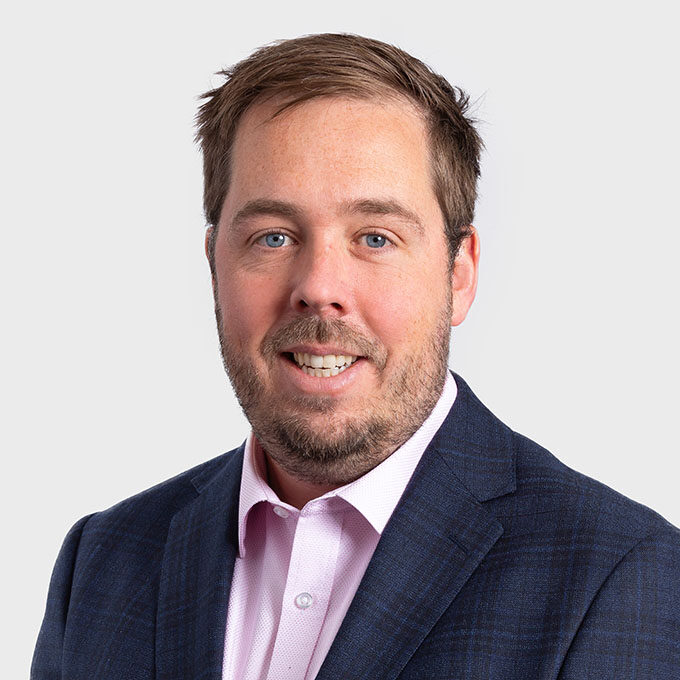
In conversation with Jamie Lane, Partner
Taking it personally
Twenty years after qualifying, Jamie Lane is still learning something new with every client, and he believes that’s exactly where the best advisers should be.
A partner in Saffery’s Bournemouth office since 2019, and non-executive director of Saffery Trust, Jamie works with owner-managed businesses, private equity-backed companies, AIM-listed firms and professional practices. Spend time with him and two things stand out: a genuine curiosity about how businesses work, and a deeply personal commitment to the clients he works with.
We sat down with him to talk about his journey, what he brings to clients, and where Saffery Bournemouth goes next.
Beginnings and values
Q: What drew you into accountancy in the first place?
A: I always knew I wanted to be in business; I just didn’t know what shape that would take. I chose not to go to university and studied AAT at Bournemouth and Poole College instead. A firm came to the college looking for accountancy trainees, I interviewed, and I got the job. Young people today have to be far more strategic about their careers. I kind of fell into mine, but it put me right at the heart of how businesses are run, and that’s exactly where I wanted to be.
Business runs in the family. My dad, my brother and my grandfather all ran their own businesses, so it was a natural interest for me. I’ve always been interested in money and how businesses make it work.
Q: What were the biggest lessons from your early career that still shape how you work?
A: Building relationships, working hard and delivering. Clients are paying for a service, and I want them to get it. If we ever fall short, I take it personally. From the very beginning, I’ve focused on reputation, relationships and client service.
And learning. That’s the biggest one of all.
Q: Are you still learning now?
A: Very much. I always tell our trainees that the day the learning curve flattens off and you stop developing, it’s time to move on. I’m forty-three, and I qualified twenty years ago this September, but I still find the job genuinely challenging, in the best way. Every client and every deal brings something new. I never want to feel completely comfortable, because that’s when you stop growing.
Every business is different. Just because you’ve worked with one manufacturer doesn’t mean you fully understand the next: they’ll have different environments, different products and different ways of doing things. Experience gives you perhaps fifty percent of what you need. The other fifty comes from getting to know the people; what makes them tick, what their strategy is, what they’re trying to achieve, and shaping the right service around that.
Q: What made Saffery stand out when you joined in 2019?
A: Three things. It was a very strong, highly respected brand. There was a real opportunity to grow the corporate side of the Bournemouth office. And it operated as a proper partnership.
The final stage of the partner recruitment process was what’s known as a “trial by canapé”… you stand in a room and the partners come and talk to you. I remember thinking, I really like these people; I can work with them. In any partnership you have to be able to trust your fellow partners, and as firms grow, that can get diluted. At Saffery, the partners I met were focused on supporting me, and that stood out.
Saffery has a fantastic reputation on the private client side for service and partner-led delivery. We bring exactly the same principles to our corporate clients, and that’s what sets us apart.
Putting clients at the centre
Q: You work with owner-managed businesses, private equity-backed companies, AIM-listed firms and professional practices. What draws you to that mix?
A: Each for different reasons. Owner-managed businesses are usually led by people who have taken something and made it amazing, and it’s a privilege to support them on that journey, helping them navigate the genuinely complex areas of tax, law and governance along the way.
Some of those clients go on to take private equity investment. Most of my private equity-backed clients are SMEs focused on scaling and professionalising, so there’s always something happening. It’s fast-paced and exciting, and when they exit at a multiple of what was invested, you see all that hard work pay off.
Q: What does that support look like in practice?
A: Over the past six months, we’ve been working with one client on a series of acquisitions and then integrating them, particularly from an accounting and tax perspective, as well as strengthening their control environment and efficiency. They were owner-managed before the investment, so they’re now professionalising the way they operate. We bring insight from across our client base, and we always keep one eye on the exit. Their stated aim is to exit by 2028, so the question is: what do they need to do now to become an investable business? We work hand in hand with our transaction services team to put them in the strongest possible position.
Q: You describe Saffery as client-centric. What does that mean?
A: I’m an audit partner by training, but my job is to bring the right services to our clients at the right time. Many firms are siloed – “I’m an audit partner, so all I’ll talk about is audit.” That isn’t how we work. We bring in our transfer pricing specialists, our transaction services team, our personal tax team to look after the directors, whatever the client needs.
It’s about the client, not how we’re structured as a business. The client has ambitions, so what resources across Saffery can help them achieve them? It isn’t fee-driven. It’s about taking it personally and wanting our clients to succeed.
Q: Do clients draw on expertise beyond Bournemouth?
A: Absolutely. COVID changed expectations. Clients will come in for meetings if that’s how they like to work, but mostly they want to pick up the phone, get the advice and solve the issue. Above all, they want a responsive service, and it’s surprising how many organisations still get that wrong. My responsibility is to make sure our clients have access to the best of Saffery, wherever it sits in the UK, at the right time and with the right approach.
Q: What’s the most common mistake you see growing businesses make before a transaction?
A: Not preparing. Many underestimate the time a transaction takes, and how important it is to have everything in order with no skeletons in the cupboard, because it all comes back to value. People see the cost of advisers, but that investment has a huge multiplier effect. If you haven’t prepared properly, a buyer will chip the price, or you won’t achieve the price in the first place.
You wouldn’t sell a house that was half falling with rubbish everywhere. A well-presented, well-prepared business sells far better. It’s about thinking clearly about who the buyer is, what they’re buying and why.
Q: You’ve led complex group reconstructions and UK GAAP to IFRS transitions. What makes such technical work satisfying?
A: Solving problems for clients. Financial reporting changes aren’t optional, clients have to comply with the rules, and they want someone who can take them through the process with clarity and confidence. Taking that weight off their shoulders is really rewarding.
Group reconstructions go further: they solve a problem and add real value. A cleaner structure makes a future sale easier, can be far more tax efficient and makes day-to-day operations simpler. We’ve saved clients significant sums of tax simply by being strategic about how a group is put together and how it operates.
Q: How do you stay close to clients while managing a growing book of complex work?
A: By having a great team around me, and by seeing clients outside of compliance meetings, over lunch, getting to know them as people. When you understand what makes someone tick, you build trust, and that relationship makes everything else work better.
Leadership, the region and what comes next
Q: You’re also non-executive director of Saffery Trust. How has that role shaped you?
A: Saffery Trust is our offshore fiduciary business. I was voted into the role in March 2025, and it’s my first senior leadership role. It’s demanding, with regular trips to Guernsey, Cayman Islands, Geneva and London, but it’s been fascinating. It has stretched me in leading people and in thinking strategically about a business outside my own technical specialism: its clients, its competition and what it stands for.
It’s also given me a newfound respect for senior leaders. It’s easy to criticise leadership when you think something’s been missed. In reality, leaders are balancing multiple demands to get the right outcome for every stakeholder. As a former managing partner used to say, there’s a lot going on under the waterline. It’s the swan analogy: serene on the surface, paddling hard underneath.
Q: What separates businesses that scale successfully from those that stall?
A: Leadership. Product or service matters, of course, but strong leadership and recruiting the right people are what separate the businesses that scale from those that don’t.
Q: How has the appetite for growth and M&A changed on the South Coast?
A: The South Coast is far more on the map than it was ten years ago. There’s an ambitious ecosystem here, and a growing recognition that businesses may need outside investment to reach the next level. Private equity is more open to the region, and the region is more open to what private equity can bring. That shift is quite recent, especially in Dorset.
It’s a great place to live, so it attracts people who want to build a business here – and businesses that might not work in London thrive here. I was in London recently, and when I mentioned how many manufacturing clients we have, the response was, “We don’t do anything like that, we only work in London.” London is dominated by service businesses. Down here, the mix is far broader: manufacturing, a big hospitality sector, and brands like Jimmy’s Iced Coffee and Gozney that have grown from a local platform into international names.
The advisory community has matured, too. There are high-quality accountancy and law firms across the region. It’s competitive, but that means businesses no longer have to go to London to get first-class support.
Q: Saffery Bournemouth has a strong presence in the local business community. What’s behind that?
A: Over the last twelve to eighteen months, it has really felt like we’re building a community. Our team events, from go-karting to rounders, have attracted great engagement across the local professional network. And many of our qualified people below partner level are out there doing business development and representing Saffery. It’s great that we support that, and great that they have the energy and drive to do it.
Q: Many firms are cutting graduate intakes because of AI. What’s Saffery’s approach?
A: Firms have taken two very different approaches. Some of the largest have made a point of cutting graduate and school leaver intakes. We’ve increased ours. My view is that AI will create more opportunities than it takes away, and I expect firms that haven’t recruited enough to feel the squeeze in two or three years’ time.
It is more uncertain than any technological change before it, and our trainees’ roles will certainly evolve over the next three years. But I believe it will make the job more interesting, improving quality and taking away the drudgery, rather than taking the job away.
Q: What would you tell a younger version of yourself starting out today?
A: The same thing I tell our younger team: always put yourself somewhere with a steep learning curve, and don’t be afraid of it. Make sure you’re always learning. The world is moving faster than it ever has, and the people who keep learning are the ones who thrive.
Q: Finally, what’s next for Saffery’s Bournemouth office?
A: Growth: creating more opportunities for our clients and our people. We have a very ambitious team, and the best way to give them the best experience and career opportunities is to keep growing across the region.
We’ve invested significantly in our office, giving us a platform to grow our headcount by around fifty per cent. We’re well positioned to do that, within a firm that is committed to the region, ambitious about growth, and able to offer clients national expertise with a local, partner-led service.
Contact us
Partner, Bournemouth
Key experience