
Corporate interest restriction: what large and growing businesses need to know

What is the Corporate Interest Restriction (CIR)?
The corporate interest restriction (CIR) rules are a key part of the UK’s corporate tax regime. They mostly affect large multinational groups with significant levels of debt.
What’s the purpose of the CIR rules?
The CIR rules are designed to stop multinational groups from claiming excessive interest deductions, which could reduce their UK tax liability unfairly. In simple terms, the rules cap the amount of interest expense a company or group can deduct from its taxable profits.
How do the CIR rules work?
The rules apply at the level of the ‘worldwide group’ – this means the ultimate parent company and all its consolidated subsidiaries, as determined under international accounting standards, although this is subject to several overrides. Unlike many other tax rules, CIR calculations are done for the group as a whole, not company by company. Any restriction on interest deductions is then allocated across the UK companies in the group.
The CIR £2 million threshold explained
A key threshold is the £2 million de minimis. If the worldwide group’s total UK net is at or below this, the CIR rules don’t apply and the full interest expense can be deducted. If the expense is above £2 million, the amount that can be deducted may be limited. This threshold is adjusted if the accounting period is longer or shorter than 12 months.
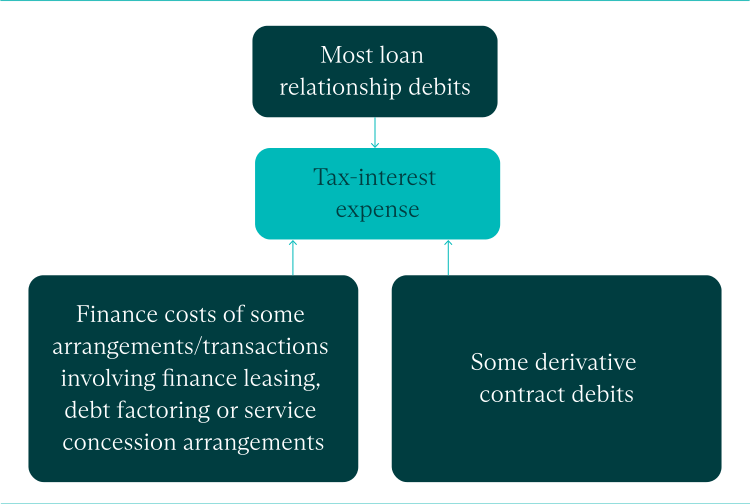
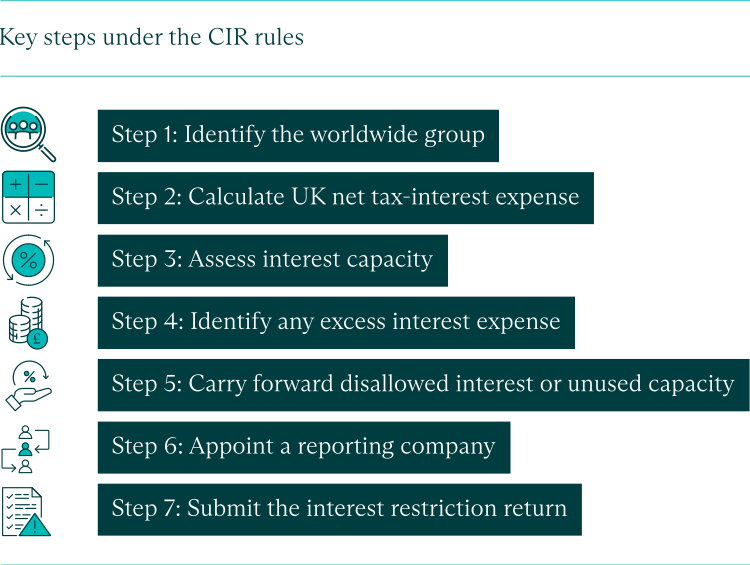
The group’s interest capacity (the maximum deductible amount) is based on its UK tax-adjusted EBITDA (earnings before interest, tax, depreciation and amortisation). If the group’s interest expense is more than this capacity, the excess is disallowed for tax purposes. However, disallowed interest and unused capacity may be carried forward to future periods, subject to certain conditions.
CIR interaction with other tax rules
The CIR rules also interact with other parts of UK tax law, including the loan relationship rules, transfer pricing, and anti-hybrid rules. These may reduce the group’s interest expense below the £2 million threshold, meaning CIR doesn’t apply. It’s also important to note that CIR applies before the loss restriction rules, which limit the use of carried-forward losses.
CIR compliance and administration requirements
The CIR rules can create a significant compliance burden. Groups need detailed data on finance-related debits and credits, which often involves co-ordinating data collection across multiple companies within the group, which can be complex and time-consuming.
Groups near the £2 million threshold should review their financing arrangements carefully to avoid falling within scope unintentionally. While groups below the threshold don’t need to file a return, they may choose to do so voluntarily, for example, to preserve carried-forward amounts.
Are SMEs affected by the CIR rules?
In practice, CIR mostly affects large multinational groups. Small and medium-sized enterprises (SMEs) are usually outside the scope, but growing businesses should be aware of the rules as they scale up.
Recent changes to CIR reporting
As announced at Autumn Budget 2025, to simplify CIR reporting and reduce administrative burdens:
- The 12-month deadline for appointing a reporting company has been removed, with retrospective appointments allowed for periods ending on or after 31 March 2024,
- From 31 March 2026, the requirement to notify HMRC of the appointment separately has been replaced by a self-certification process within the CIR return, and
- Groups need to reconfirm the reporting company for each period, as appointments no longer roll forward automatically.
However, a new £1,000 penalty applies if a CIR return is submitted without a validly appointed reporting company.
How Saffery helps businesses navigate CIR
Our team of corporate tax experts has extensive experience advising UK and international groups on the CIR rules. We can support you with:
- Assessing whether your group is within scope of the CIR rules,
- Calculating UK net tax-interest expense and interest capacity,
- Preparing and submitting interest restriction returns,
- Reviewing financing arrangements to manage exposure to the CIR rules,
- Advising on interactions with other tax rules, such as transfer pricing and anti-hybrid provisions, and
- Supporting growing businesses as they approach the CIR threshold.
Whether you’re considering the rules for the first time or reviewing your group’s current approach, we can assist you.