UK e-invoicing mandate 2029: what SMEs need to know and how to prepare now

E-invoicing will become mandatory in the UK from 2029, yet many businesses have not begun to prepare for the transition.
HMRC’s recent study into e-invoicing awareness in SMEs found that c40% of organisations were unaware of upcoming changes and, more worryingly, c90%+ had not seen any HMRC communications on the topic. While the research highlights awareness of e-invoicing is growing, HMRC and advisors have much to do ahead of 2029 to help organisations meet the requirement.
While the UK’s 2029 e‑invoicing rollout may feel distant, organisations should begin familiarising themselves with the requirements. Global research referenced by HMRC has identified a typical small organisation can save c£11,000 per annum by adopting e-invoicing. While the full extent of the benefits is still to be proven, structured invoicing does have the potential to improve matching accuracy, reduce disputes and streamline approvals. Over time, these efficiencies support more predictable payment cycles and strengthen cash flow management.
When mandatory e-invoicing arrives, businesses will be required to issue B2B and B2G invoices electronically to contribute to ongoing efforts to close the ‘tax gap’, which also include digital tax returns, increased use of financial and bank data and the use of AI.
Update – July 2026
HMRC has now confirmed that Peppol will be the core interoperability network for the UK’s planned e-invoicing mandate from 2029. This provides businesses with greater clarity on the likely framework for implementation and should help organisations begin assessing their systems, processes and software providers’ readiness for the transition. You can read more about this in our July VAT Update.
What is e-invoicing and how does it differ from pdf invoices?
An e-invoice is not a PDF or a Word document. It’s an invoice issued, transmitted and received in a structured digital format that allows for automatic processing by systems, without manual intervention. Structured invoices enable data to flow directly from a supplier’s system into a customer’s accounts payable process, and onwards into reporting, reconciliation and compliance activities. That capability is what underpins the wider benefits, and why governments globally are moving towards e-invoicing and real‑time‑reporting models.
How e-invoicing will work in the UK
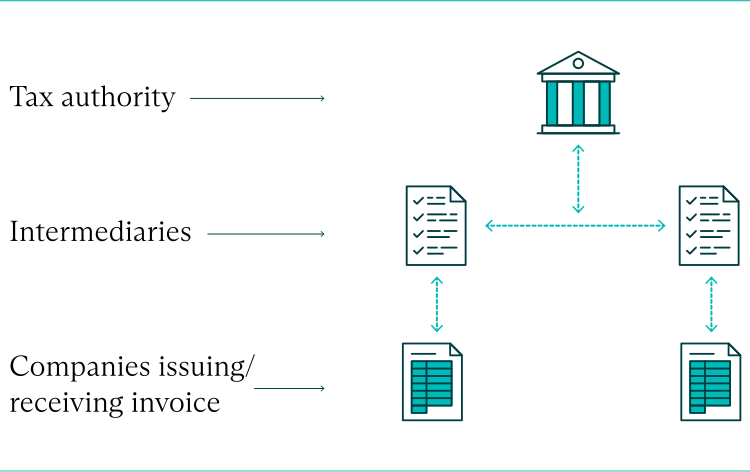
While details remain scarce, it’s likely the UK will move to an initial ‘four-corner’ e-invoicing model (see below). This means organisations will send and receive invoices via intermediary access points, who can help translate specific invoice formats into standard ones and share the invoices with the recipient’s service provider, allowing for greater interoperability between different accounting/finance platforms.
HMRC will not approve or reject invoices, as is the case in centralised models found in other countries; however, they have communicated a plan to have access to the data in the near future. This would mean turning the four-corner model into a five-corner or Y-model and would provide greater levels of data to move to pre-filled tax returns.
The four and five corner e-invoicing model
The UK e-invoicing landscape today
- HMRC’s quantitative research into SME usage and attitudes found that around 59% of SMEs say they are familiar with e-invoicing, yet only 29% actually use it, and just 10% both send and receive e-invoices. Medium-sized businesses are more advanced than smaller firms, but overall non-mandatory adoption remains low.
- The most common invoicing method by a wide margin is still PDF invoices sent by email, followed by paper invoices, particularly on the receiving side. This matters because PDFs and scanned documents may be digital, but they are not structured. They still rely on manual handling, re‑keying and human interpretation, which introduces cost, delay and error.
- At the same time, the research shows encouraging signs: almost all SMEs already use accounting software, with only a very small minority reporting that they use none at all. This suggests that, due to the hard work of organisations like our Accounting Software partners, e-invoicing functionality will be available to most organisations.
Why treating e-invoicing as a tax project limits business value
In some ways, SMEs are in a better position than large corporates to adopt e-invoicing, as their smaller teams, with people wearing many hats, allow for quicker changes. For larger corporates, where responsibility can be more siloed, it may be easy to assume e-invoicing is purely as a tax responsibility due to HMRC’s involvement, but doing so creates two main risks:
- Minimum compliance: projects led only by tax or finance often focus on minimum compliance, rather than the invoicing process that also includes disputes, credit terms etc.
- Short-term fixes: tactical solutions are bolted on, rather than designing a scalable digital process aligned to future business growth and business strategy.
Best practice e-invoicing programmes
Best practice e-invoicing programmes consistently combine the people who are responsible for invoicing processes, IT and finance/tax.
What SMEs should do now to prepare for e-invoicing
HMRC’s research shows that most SMEs look to software providers and advisers for guidance on e-invoicing. That places an opportunity, and a responsibility, on leadership teams to take a proactive, business-led approach. With HMRC having confirmed Peppol as the core interoperability network for the planned 2029 mandate, businesses have greater certainty about the direction of travel and can begin assessing their readiness accordingly.
Key principles for SMEs include:
- Start with the process, not the mandate: understand how invoices flow through your business today and where friction exists.
- Design for exceptions: over 90% of invoices will flow through without issue, but disputes, credits and errors do not disappear with e-invoicing; they need clear handling.
- Think end-to-end: invoicing can sit between sales, operations, finance and tax teams. The value comes from joining these up.
- Focus on data quality: clean, consistent master data delivers more value than any single technology choice.
Practical next steps for UK businesses
- Engage with HMRC consultations directly or through advisers,
- Notify stakeholders early (including tax, finance, IT, procurement, sales) and build this into finance roadmaps, and
- Review your finance operations to assess what changes may be required to enable e-invoicing smoothly, including technology, operations, operating model and data.
How Saffery can support your transition to e-invoicing
Saffery brings together deep tax, accounting and technology expertise to support organisations at every stage of their move to e-invoicing. Our combined tax and accounting teams have significant experience in:
- Finance function review and transformation, across the full company size spectrum – from SMEs and owner-managed businesses to large and complex corporates.
- Accounting system selection, implementation and migration, with particular strength in ERP and finance platforms applicable to small to mid-sized firms.
- E-invoicing software selection and global implementation, including experience of engaging directly with tax authorities.
- Design and operation of global e-invoicing governance frameworks, including leading e-invoicing programmes for a global FTSE 100 organisation.
- International VAT advisory and control automation, supporting compliant and scalable indirect tax processes.
In addition, Saffery individuals sit on relevant HMRC and professional body forums relating to e-invoicing. This enables us not only to contribute informed feedback, but also to maintain an understanding of the latest HMRC thinking and policy direction.
If you’d like to discuss any of the topics covered in this article, please get in touch.
Contact us

Partner, Bristol
Key experience